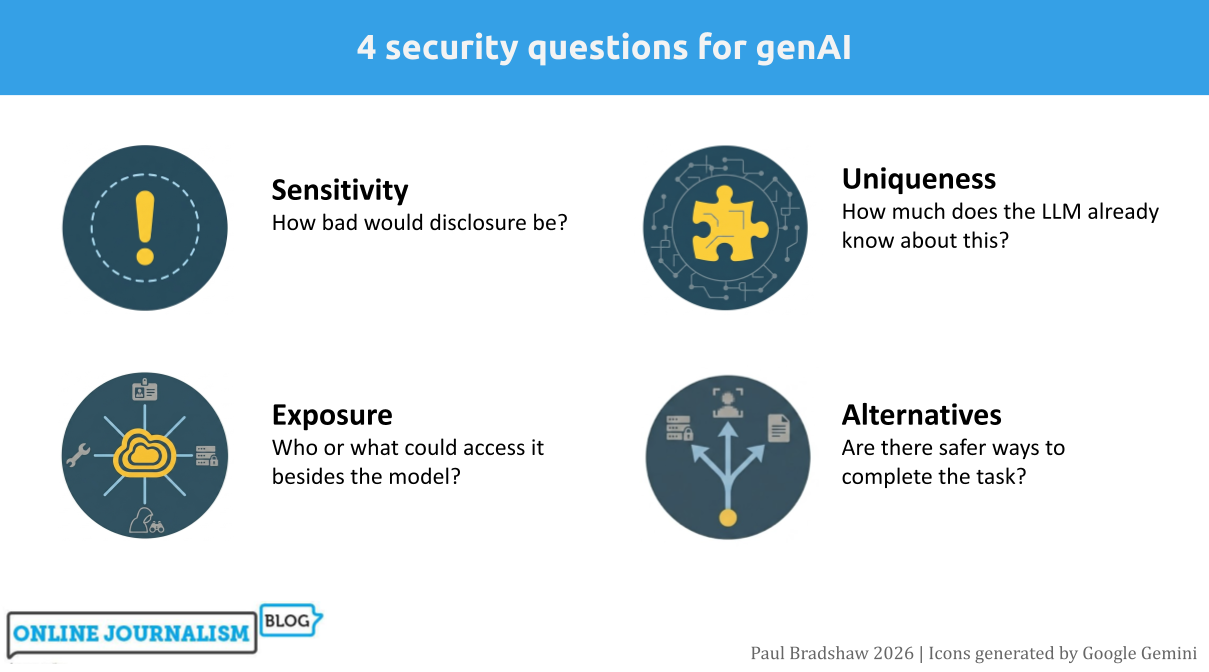
What are the risks of information you put into an AI chat becoming public? Evaluating those risks is slightly different to other information security challenges because of the way large language models work, so here’s a guide to assessing and managing information security with AI.
In a guest post for OJB, James Hickman pulls together a set of basic best-practice guidelines for creating data journalism videos on TikTok, from length and location to animation and style.
Short-form vertical video is quickly becoming a key format for telling all types of news stories — and data journalism is no exception.
As a data journalist, I wanted to know how these outlets use this new and evolving digital video format to create “data shorts”: short-form social media videos in a vertical, reel-style format, that analyses or reports on specific datasets or newly released data.
The latest “wife of” headline — ITV News’s report on the actor Lisa Faulkner revealing that she has undergone surgery after a cancer diagnosis — is an opportunity to get journalism students exploring how different forms of bias might shape news reporting — and not just the obvious ones.
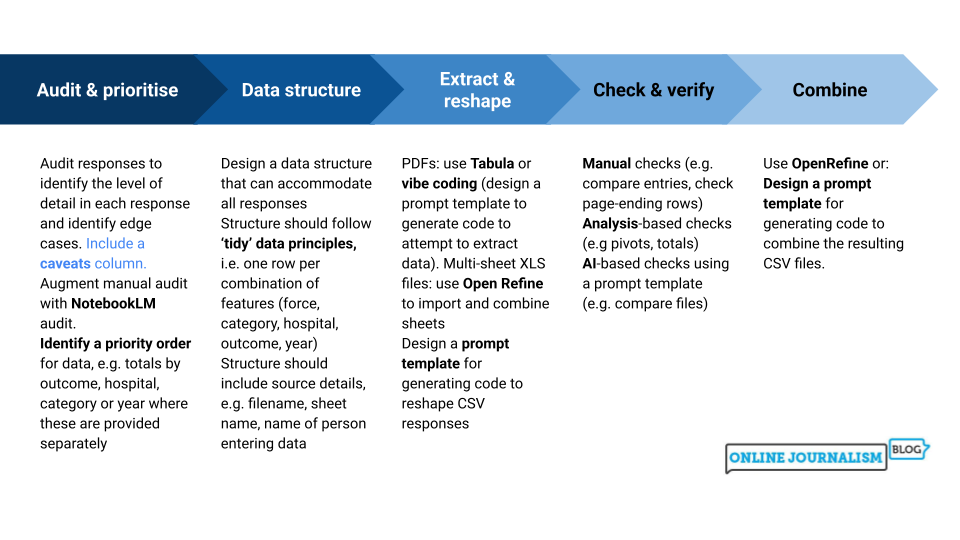
Sending FOIs to multiple bodies across the country to get the big picture on an issue sounds like a great idea — until the responses start to trickle in. Differences between responses often make mass FOI projects extremely time-consuming as you try to get everything into a format that allows you to ask journalistic questions and compare different authorities. Can AI help?
On one recent project I decided to put together a methodology that made the process less stressful, faster and more accurate. Here’s how it works.
Using visualisation on TV and video is very different to using charts and maps online. In video, the audience has very little time to absorb the information contained in the chart — so you need to get them to that information as quickly as possible.
Every bad example of charts in videos forgets this. And every good example uses two essential techniques: keeping things simple, and adding motion.
Some essential reading by Agnes Stenbom Swedling explores how news organisations integrate AI into their workflows and the idea of the “human in the loop“. Many newsrooms, she points out, “are not optimised for what humans do best”, and so far the introduction of AI hasn’t involved a critical consideration of whether we want to embed those features in new systems, or rethink them:
“What is being built – incrementally, often unintentionally – is a form of machine-centric hybridisation. Workflows are optimised for what machines do well: speed, scale, pattern recognition, cost efficiency. Humans are then positioned around those systems, adapting their tasks, roles, and decision-making to fit the logics of machines.
“The consequence is a subtle but significant inversion: rather than engaging in uniquely human activities, work is reorganised to fit machine-driven processes. And once that inversion is embedded at the infrastructural level, it becomes increasingly difficult to reverse.”
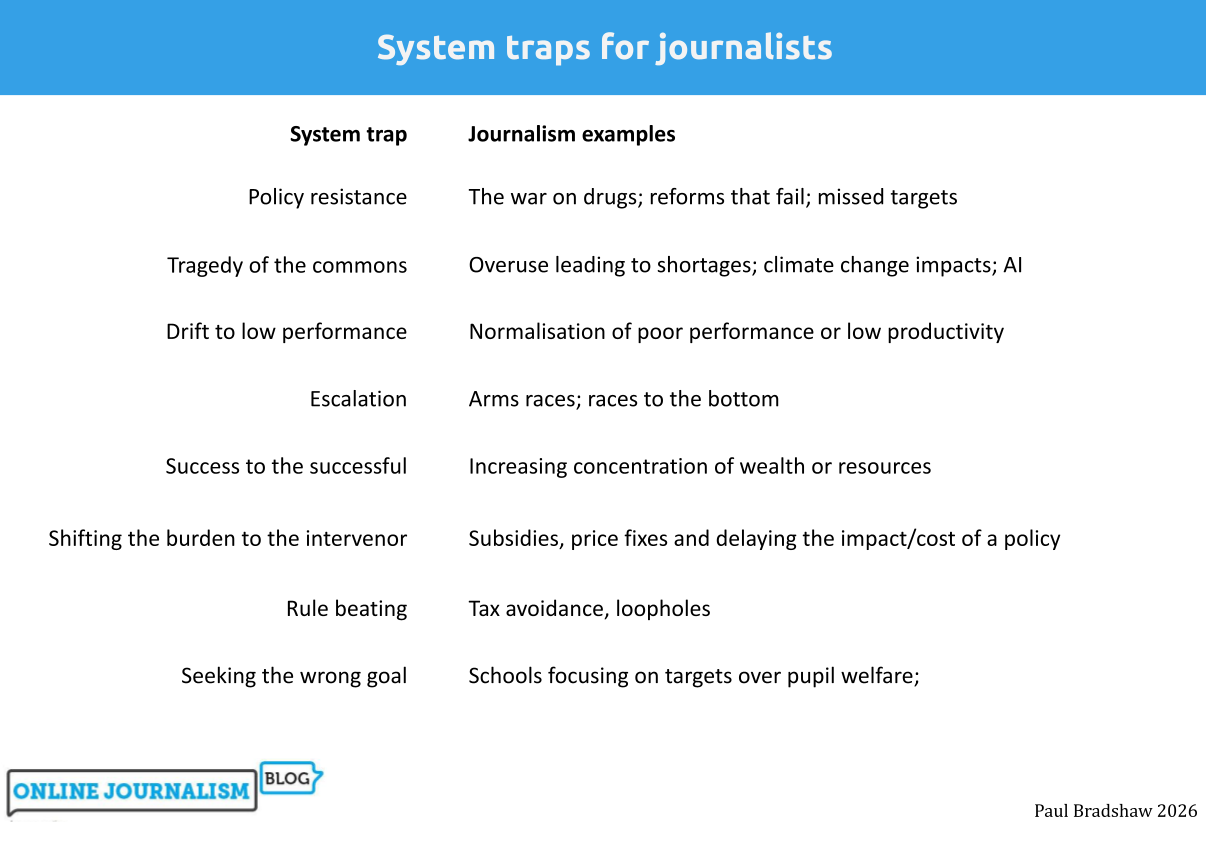
One of the most powerful ways to generate original journalism is to look at the systems behind stories — particularly the points where those systems fail.
For investigative work, those points are central. Surface-level scandals often stem from deeper systemic problems. So what tools do we have for recognising those patterns?
Donella Meadows’s classic book Thinking in Systems offers one: “system traps” — patterns that explain how systems get stuck, break down, or behave in ways nobody intends. They are “traps” because attempts to escape them often backfire.
In this post I’ll explain each trap, what it looks like in the wild, and how to use it as a lens for story ideas.
At this year’s Dataharvest I delivered a workshop on using Python in QGIS to automate the process of exporting maps for multiple locations. Here’s how to do it (you can find a GitHub repository with materials and links here).
Making a map for a story is cool — but what if you could make a map for every reader? Or if you’re working on a project involving teams in different regions or countries, what if you could give each one of those teams a map centred on their own patch?
Normally you would have to manually move the map to centre it on a key city, and then export an image. Then do it again and again and again for every area.
Luckily, QGIS has the ability to run code. And this is a great excuse to start using it.
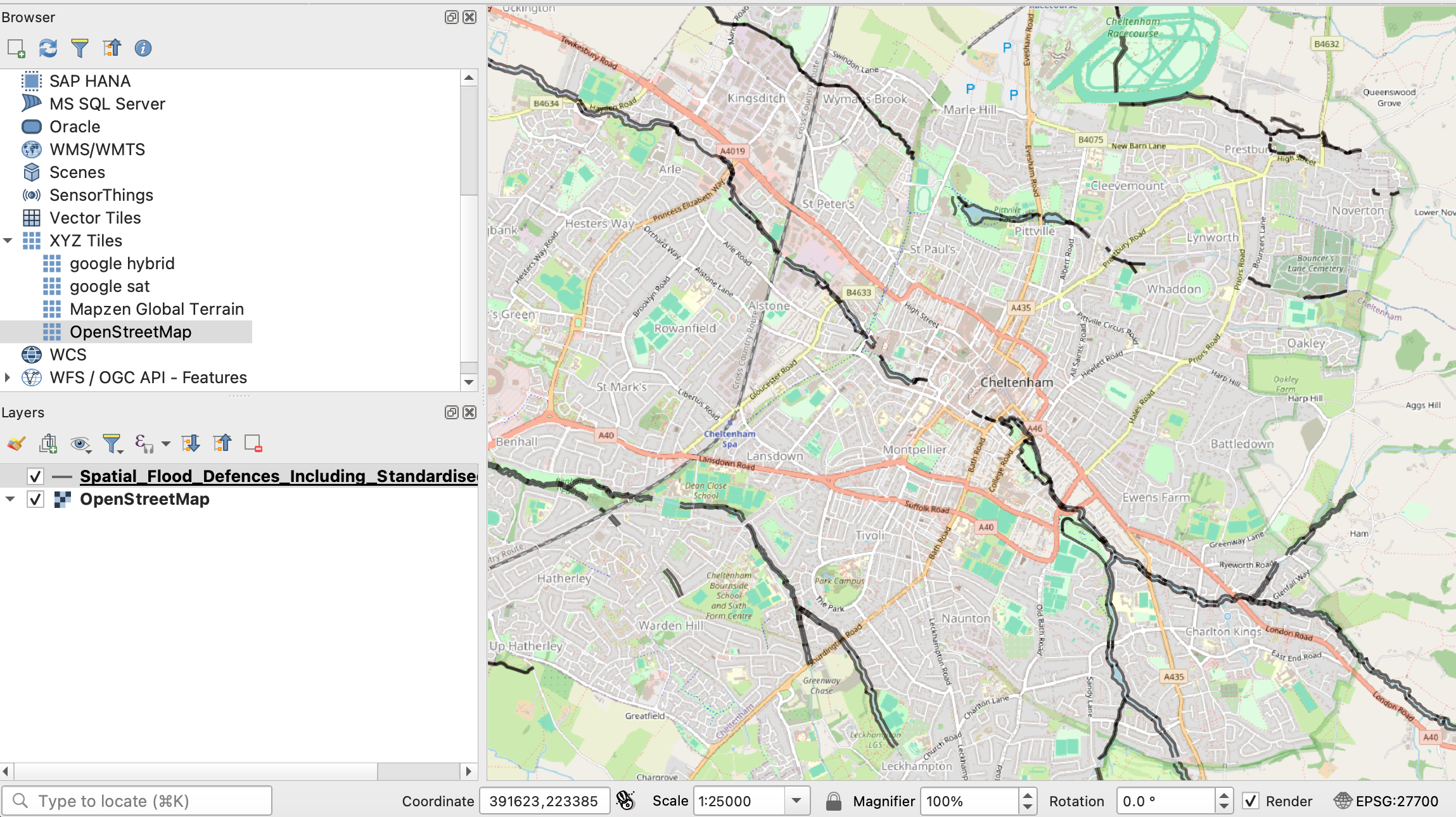
By organising the layers on the left you can put shapes such as flood defences over a base OpenStreetMap layer. You can also change the scale in the box underneath the mapContinue reading →
In this latest post in the FAQ series, I am sharing some responses to a radio interview about AI’s impact on journalism.
Q: Is the continuous growth of AI-generated content online a danger for journalism?
It is certainly a problem yes, in three ways: it makes reporting harder, it makes it harder to support journalism financially, and it makes it harder for audiences to trust your reporting.
Documents and other collections of text can be goldmines for data journalism — if you know how to approach them as data. Here are some techniques and inspiration for your next data project.
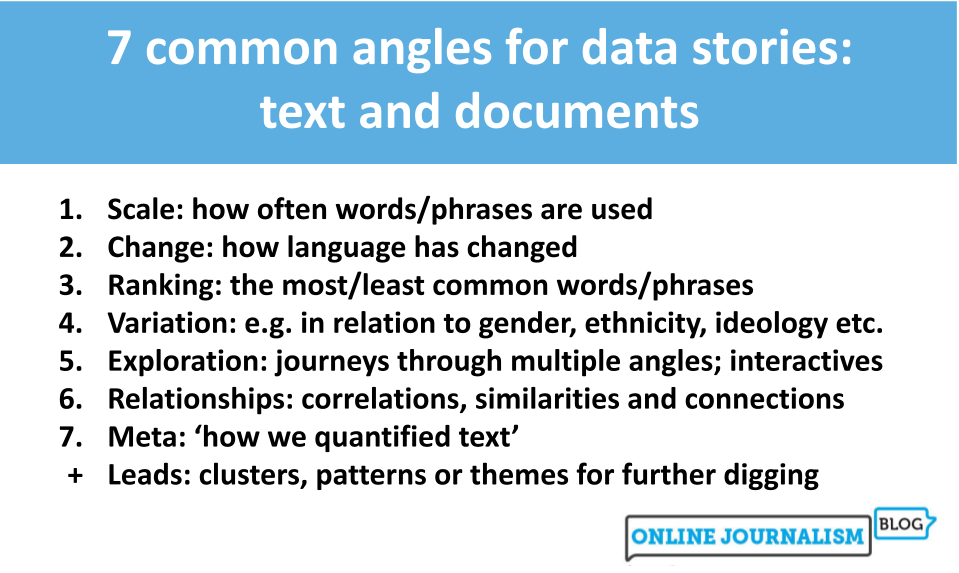
Looking at those articles it’s clear that, once quantified, journalists tell the same stories about text as any other piece of data: using the seven most common angles.
But how those angles are used — and how often — is where it gets interesting…